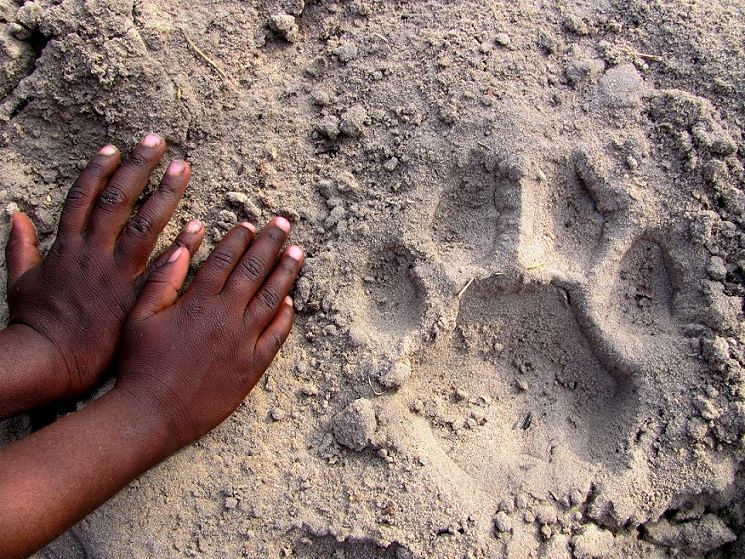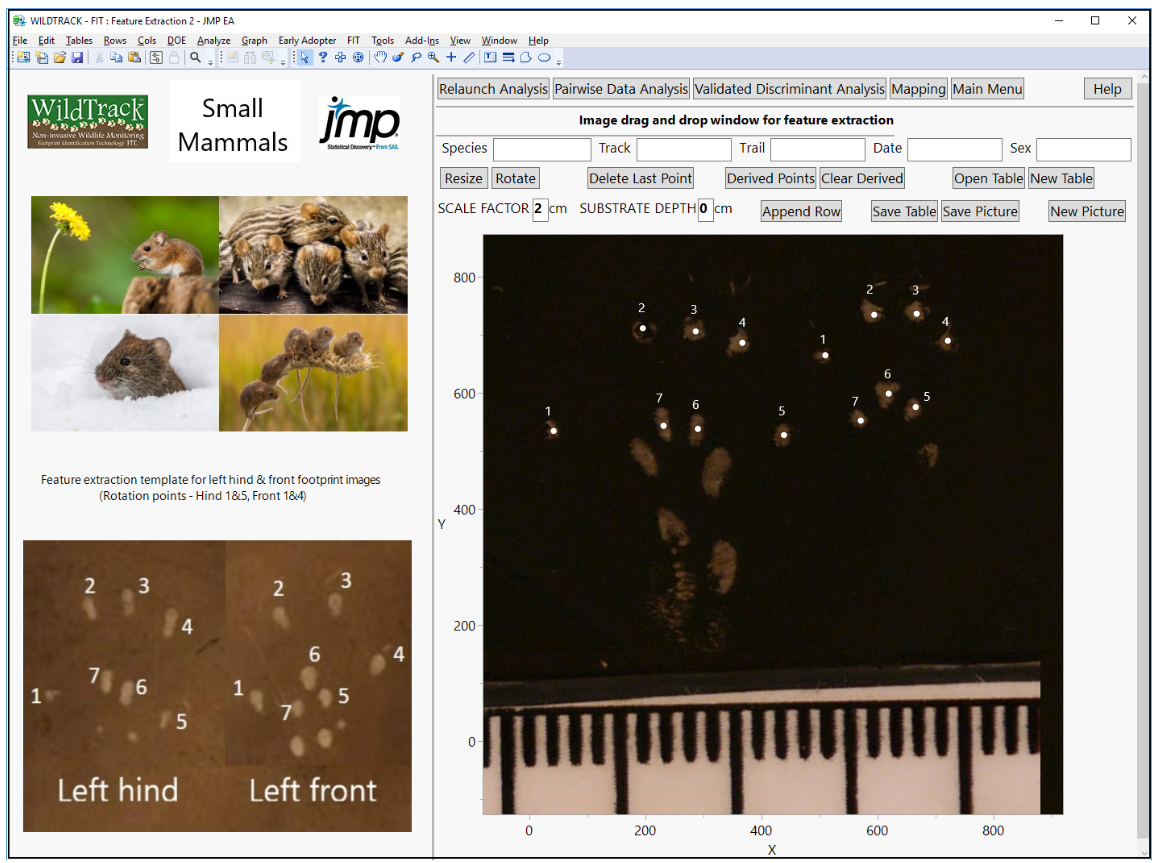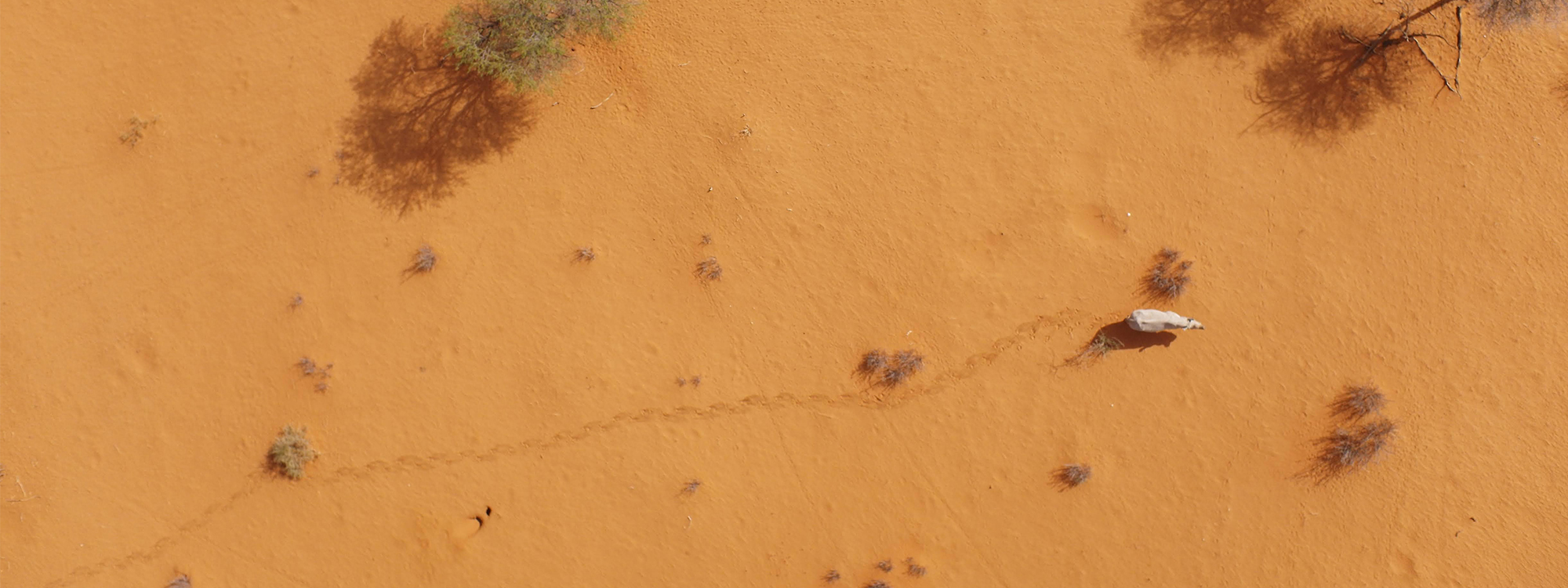
WildTrack has developed a non-invasive Footprint Identification Technique (FIT) which can identify endangered animals at the species, individual, age-class and sex levels. Animals have unique feet, in the same way that humans have unique fingerprints. This allows us to monitor their status and work with decision-makers in environmental and conservation sciences to implement effective policies.Polar bear front view
Using footprints to monitor
endangered species is non-invasive and cost-effective. It is therefore a sustainable solution, particularly for elusive species, and sustainability is vital if conservation is to be successful. Moreover, since FIT is based on the ancient tracking techniques used by indigenous trackers, it engages local communities in the conservation effort – this too is generally recognised to be essential to the success of any wildlife conservation effort.
Footprin
ts can be found on a variety of different substrates. This left front footprint image from a Polar bear illustrates the excellent detail which can be obtained, even in snow, one of the most challenging substrates to work with.
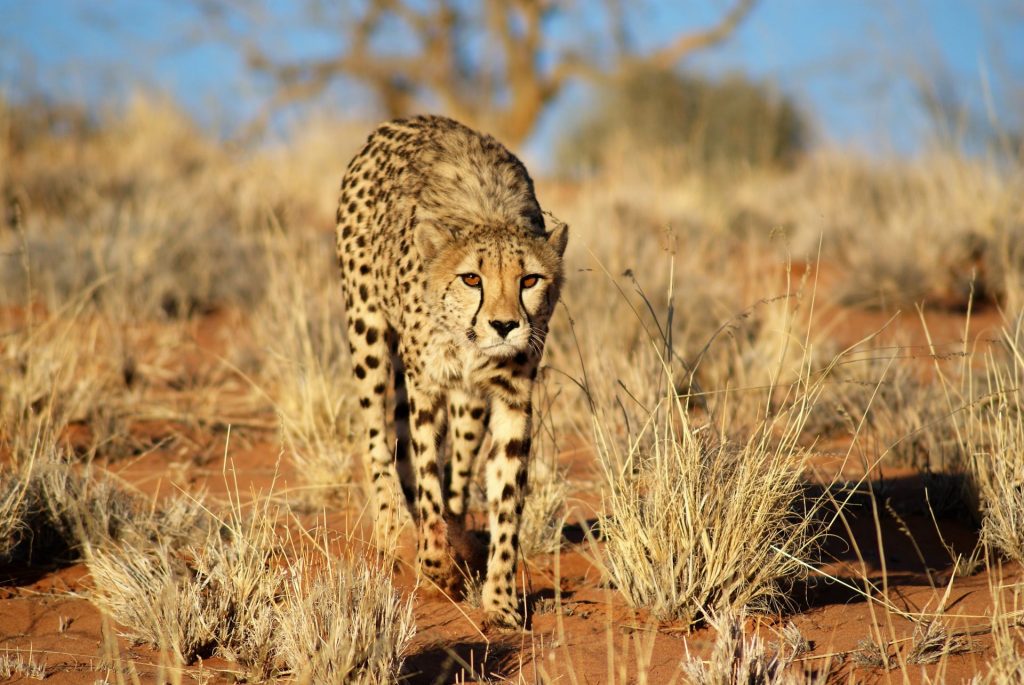
WildTrack has projects helping develop and implement FIT across the world, from the Polar bear in the Arctic to the mountain lion in Texas, to the cheetah in Southern Africa…..even the tiny dormouse in the UK.
Helping us in our work are experts in computer vision, statistics, software and design engineering, forensics, biometrics, photography and the life sciences. Why not explore our site and come join us?!
In late 2008, on the eve of a global financial crisis, delegates from the world conservation community met at the IUCN World Conservation Congress in Barcelona, Spain. 1800 scientists from 130 countries presented a shocking Global Mammal Assessment containing shocking data: 25%-36% of the world’s mammals, alone, are now threatened with extinction. The meeting concluded by releasing this statement: “The costs of biodiversity losses are not only greater than those of the current financial crisis, but in many cases, the losses are irreparable”. So it’s clear this is a problem we need to deal with quickly and effectively. But how?
Choose an endangered species….. the black rhino, the tiger…..or the tiny common European dormouse. How can we conserve it? We’d obviously need to protect the animals from poachers, habitat destruction, pollution and human encroachment. Perhaps we would also want to provide a sanctuary for them to breed without threat. But where to begin? Most conservationists would agree that the first move is to determine how many animals there are, and where they are. But, many endangered species are elusive, and difficult to see. They are often found in the last wildernesses on earth, in remote places. Common wildlife monitoring methods can be expensive and thus unsustainable, and invasive techniques, such as radio-collaring, trapping/immobilization and marking can have negative effects on the very animals they are designed to protect.
Why monitor endangered species?
Why the need to monitor endangered species? We face an unprecedented crisis in the loss of biodiversity on our planet. UNEP, the United Nations Environment Program, estimates that between 150 and 200 species are currently being lost every day. The renowned American evolutionary biologist, E.O, Wilson estimated that by 2100, half of all our current species will be lost if we continue as we are. This mass extinction is due, in large part, to unsustainable methods of production and consumption. We estimate that there may be as many as 100 million different species on this planet, of which only 1.7 million have been identified.
The Global Mammal Assessment, presented in 2008 by more than 1800 research groups in 130 countries indicated that between 25 and 36% of all mammal species may be in danger of extinction, due to various threats ranging from habitat destruction or ecosystem change such as reduction of prey species, illegal poaching and climate change. 
A further 836 species have such a paucity of data on numbers and distribution that we are unable to ascertain their status. This is a potentially catastrophic change to the world as we know it today. Many of these endangered species are flagships for their ecosystems. If they go, our motivation to protect their environments will be much reduced.
However, there are many approaches to a successful conservation strategy. The top priority, most conservationists would now agree, is firstly to secure and protect the natural habitat required by each species in as pristine an ecological state as possible, and then secondly to monitor the progress of species within that habitat. We urgently need methods for monitoring which will be cost-effective, objective and non-invasive, to give us the data we need on the numbers and distribution of these endangered species.
Summer 2013 Featured Project: The Amur Tiger in North-East China
In December 2011 we visited north-east China, at the invitation of WWF China and Dr Guangshun Jiang’s team at the North-East Forestry University (NEFU). They are developing innovative new approaches to monitoring the remaining few Amur tiger in China, and contacted us to find out whether FIT might be able to help.
The Amur tiger population in China is contiguous with a much larger population in Russia, now thought to number around 400-450 individuals. WWF China would like to encourage this population to expand back into it’s original range in China. The main challenges to be overcome are increasing the prey-base, and reducing illegal killing. Central to progress is a better understanding of numbers and distribution. FIT may provide an inexpensive and accurate tool in this quest.
This year we collected footprints from 40 captive Amur tigers in China. Using FIT in JMP software we have been able to develop an algorithm to identify individuals and the sex of these individuals. Also, Dr Jiang’s team collected seven long footprint trails from free-ranging tigers in a short period of time. Using the captive training set, we concluded that these trails were made by 4-5 different individuals.
FIT appears to show considerable promise as a monitoring tool for Amur tiger in the snow. We now need to collect more prints from free-ranging tigers and validate FIT for known free-ranging populations over the next 2-3 years, and funding to support this project.